
Too much to do, too little time
The long queues at the check-in desks are not the best advertisement for an event. Unfortunately, they are an image that somehow belongs to it. And one that is strong enough to stick in your mind and significantly influence your opinion of the event. Is a conference well or poorly organized? Part of the answer is given to the participants at the entrance.
This becomes a problem at many conferences because there is no day when the rush is greater than on the very first day. Even the best and most thorough preparation is no guarantee that questions and situations won’t suddenly arise that nobody has thought of yet.
It’s good to have enough staff on hand to look for answers and solutions. Unfortunately, as long as participants still have to be checked in, there is usually not enough time.
Why self-service is becoming a game changer at conferences
Self-service stations make life easier for organizers and participants alike. With the help of the stations, everyone can check in completely independently when they arrive on site.
All you need is conference management software and the appropriate devices that are able to work with the software.
The right scanners for self-service
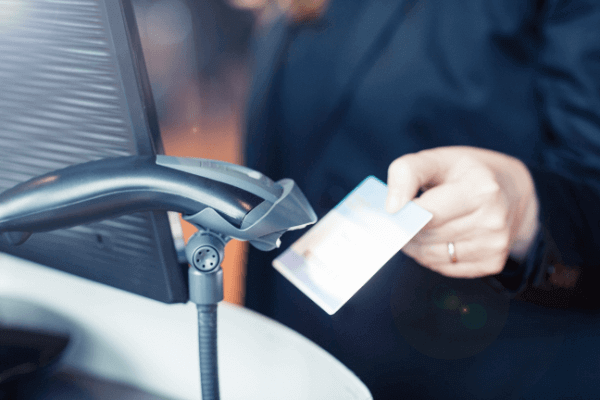
However, not all scanners are the same: there are many different models. The most important thing is what type of code you want to capture. Not every scanner can read every type of code. While some models can only handle linear barcodes, others can also scan 2D codes or QR codes. Handheld or stand scanners are also the most common at conferences. The latter are a little more elegant because attendees only have to hold their ticket underneath them for a short time.
The right displays for self-service
The display doesn’t necessarily have to feel like a self-check-in at the airport. A kiosk solution is just one option for checking in at conferences, as tablets, laptops or monitors work just as well.
What you end up seeing on the screens should also not follow the principles of the software manufacturer from a design point of view. If the menu of the self-service check-in matches the conference design, this results in a much nicer, harmonious overall picture.
And what about the time spent on self-service at conferences?
This isn’t necessary in this case, as the primary goal is to prevent anyone from wasting time unnecessarily on check-in. Arrive, scan your ticket, and immediately join the other visitors with your printed name tag – that’s all that needs to be done at the self-service station.
Ultimately, self-check-in saves valuable time that participants can spend more usefully than constantly looking at the clock in the seemingly endless queue.
This also leaves more time for staff. Self-service does not mean that the team is no longer needed, but that they finally have enough space to be available to answer participants’ questions. At some conferences, it is all too easy to get the impression that participants are simply “processed” when they arrive. Some people don’t even dare to ask their questions because the next ones are already waiting impatiently for their turn.
Self-service at conferences is anonymous and impersonal
A widespread prejudice held by opponents of self-service is that it makes arriving at a conference completely impersonal. This is wrong. On the contrary, it finally gives you time to solve problems in peace. The thought of being left alone with the check-in station could set alarm bells ringing, especially for participants who are not very tech-savvy. In reality, no one faces an insurmountable hurdle, as the operation is very simple. Most of the process is automated anyway, so people don’t have to enter, select or confirm anything. However, if there are any problems or reservations, the staff will deal with them.
However, find out in advance whether your conference management software can meet your requirements. If not, it is advisable to consider changing providers, because ultimately the system should fit your conference, not the other way around.
It’s never too late to register
Organizers of some conferences are also happy to welcome participants who spontaneously decide to attend the event. You can also implement this with the help of a self-service solution. People then fill out the same registration form on site as with the usual online registration and can also see immediately if workshops or sessions are already fully booked.
One more thing is missing before we can move on to the first item on the conference program: the name badge. Printing the badge is also part of the self-service solution. The second part of our series on self-service reveals which variants and devices you can choose from.
1. If you like ticking off checklists, you will find one here for checking in at conferences.
2. Do you organize medical conferences and participation earns you continuing education points? This is also much easier with a scan.
3. How about letting your participants check in themselves at the next conference? We would be happy to advise you and answer any questions you may have about self-service stations. Contact us directly here.