1. They organize scientific or complex events
Congresses, conferences and scientific events have requirements that that standard event management tools simply do not address: abstract management, multi-stage review processes, different participant groups with different rights and prices, sponsor and exhibitor management.
Converia was developed precisely for these scenarios. The processes are already mapped in the system. No workarounds, additional tools, or custom-built forms are needed.
2.You want less manual effort
Many event organizers come to us from similar situations: participant data is scattered across multiple lists, invoices are written manually, and changes require back and forth coordination via email. Sometimes, this stems from a custom solution built into the organization’s CMS or a proprietary app, the maintenance of which has long since become too much for the team to handle.
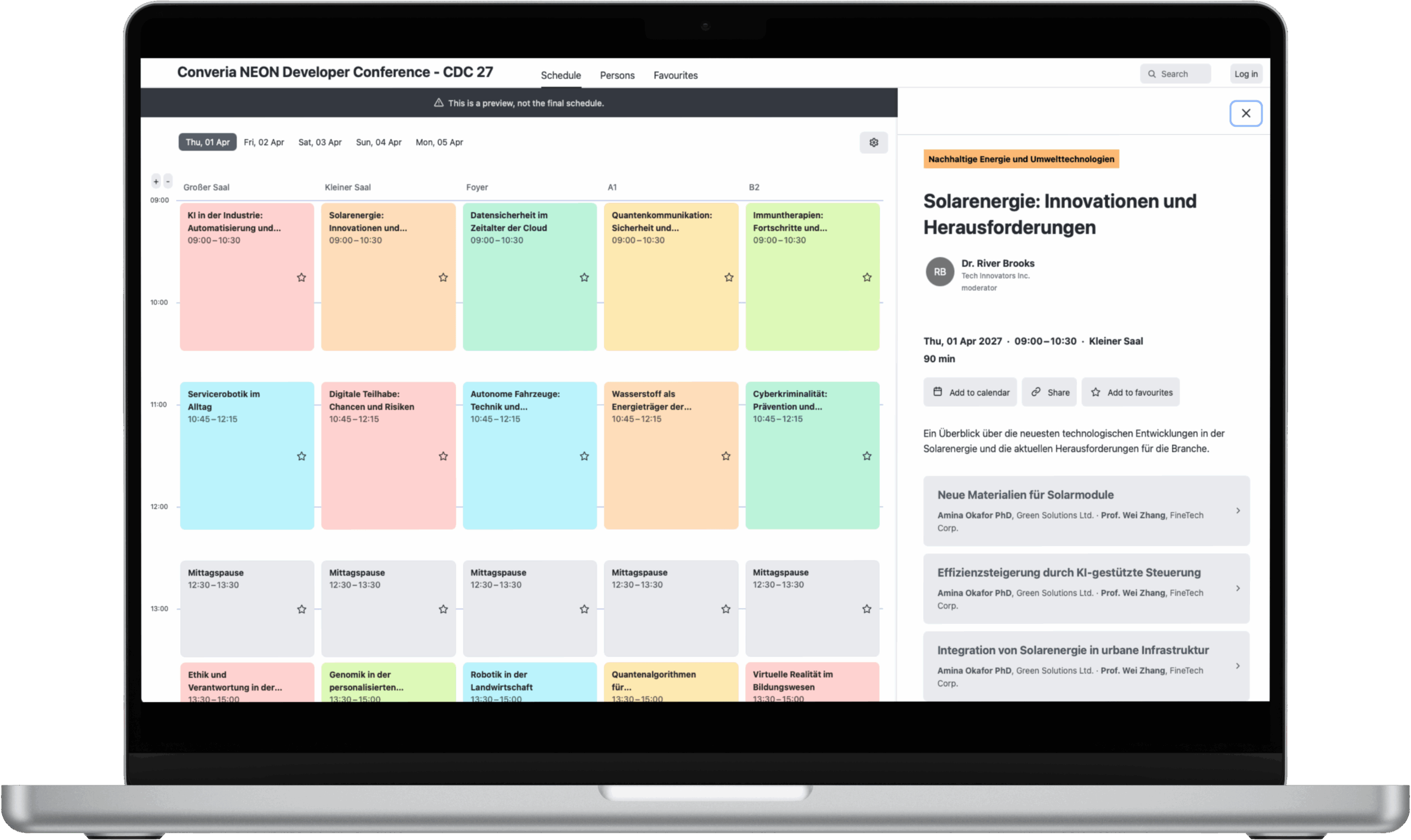
Converia combines registration, invoicing, payment management, communication, and program planning in a single database. What previously involved multiple steps and potential errors is now automated and therefore consistent.
3. Your events have complex billing requirements
This is a point that often surprises potential clients in discussions: how much is involved in the accounting of a congress that a simple ticketing solution cannot capture.
Converia supports mixed tax rates within a single event, reverse charge for international participants, and differentiated pricing structures – such as early-bird prices directly linked to the ticket type and not as a separate ticket. While this may sound rather technical at first glance, in practice it makes all the difference between clean accounting and manual corrections.
4. You want to map as many processes as possible in one system
Those who organize conferences today often juggle multiple tools: one for registration, one for the program, one for abstract submission, and yet another for communication. Each interface is a potential source of error.
Converia closes these gaps. A shared database means: participant data does not need to be synchronized, program changes are immediately available in all relevant places, and evaluations are based on a consistent data set.
The integration of this data enables event organizers to act quickly and effectively: for example, when it comes to reminding all accepted speakers who haven’t yet booked a ticket. With distributed systems, this is a complicated process. In Converia, it’s a matter of just a few clicks.
5. Your events are held annually
While Converia is also very valuable for one-off events, one of its strongest advantages only becomes apparent over time. Those who organize the same congress year after year build a growing system within Converia: participants have existing accounts, making interaction with the system easier. Historical data is retained, enabling cost-benefit analyses over several years. The participant pool grows with each event and can be strategically leveraged: for newsletters, early bird discounts, and communication with loyal attendees.
For professional associations and universities that operate a stable event portfolio, this is a clear strategic advantage.
Large organizations with distributed event teams – such as universities – deliberately choose Converia to establish uniform legal standards across the entire organization, for example regarding accounting, data protection and accessibility.
6. You want a contact person, not just a ticketing system.
Providing support for software issues is one thing. What many of our customers appreciate goes beyond that: that we think ahead, even when the question isn’t actually a software issue.
Two practical examples:
An event organizer approached us with a problem: a project partner was demanding a specific billing method that couldn’t be implemented in any existing system – and threatened to terminate the collaboration. We then examined the situation, questioned the partner’s legal assessment, and demonstrated with well-founded arguments that the demand was untenable. This resolved the problem without anyone having to manually create invoices.
In another case, the legal department of a conference partner asked our client to introduce a cancellation form. Instead of simply implementing this, we discussed whether it was even legally required. The result: it wasn’t. Instead of unnecessarily opening the door to free cancellations, the client found a better solution – because we didn’t just nod along.
Who is Converia suitable for – and who is it not suitable for?
Converia is a good choice if you:
- Organizing congresses, conferences or scientific events
- Conducting events with complex participant groups, pricing structures, or billing requirements
- Managing several events per year – or building a recurring event over the long term
- Want to centralize many processes in one system
- Finding a contact person who thinks along with you.
Converia is probably not the right choice if you:
- occasionally organize small events with simple ticketing
- organize exclusively free events
- plan an entertainment event
If you identify with the points above and would like to learn more: We would be happy to discuss with you whether and how Converia fits your situation.